Gordigear Tanami Light 140 vs RoofBunk Explorer
The Gordigear Tanami Light 140 and the RoofBunk Explorer are both softshell tents in the same part of the market, which makes them a genuine head-to-head rather than a comparison across categories. Gordigear and RoofBunk take noticeably different approaches to the same problem.
By the numbers, the Gordigear Tanami Light 140 brings 52 kg, 3.46 m² of floor, 130 cm of headroom and sleeps 2. The RoofBunk Explorer counters with 50 kg, 4.34 m² of floor, 130 cm of headroom and sleeps 3.
On weight they are effectively level — 52 kg against 50 kg — so the roof load question resolves the same way for both. Inside, the Explorer gives 4.34 m² of sleeping floor against 3.46 m², about 25 percent more, and it sleeps 3 to the Tanami Light 140's 2. Setup is not close. The Tanami Light 140 opens as a fold-out in 120 seconds; the Explorer takes 4 minutes. Over a trip with a new campsite every night, that gap compounds. Their list prices are within a few percent of each other, so price is unlikely to decide this one.
Canvas differs too: 265 gr/m2 ripstop polyester-cotton blend, polyurethane impregnated and UV resistant against 320gsm poly-cotton blend ripstop canvas body; 600D Oxford polyester rainfly. The Explorer adds a roof skylight and integrated LED lighting, which the Tanami Light 140 does not offer. Closed, the Explorer sits 5 cm lower on the roof — 30 cm against 35 cm — which is drag you carry on every mile you are not camping.
Gordigear
Tanami Light 140
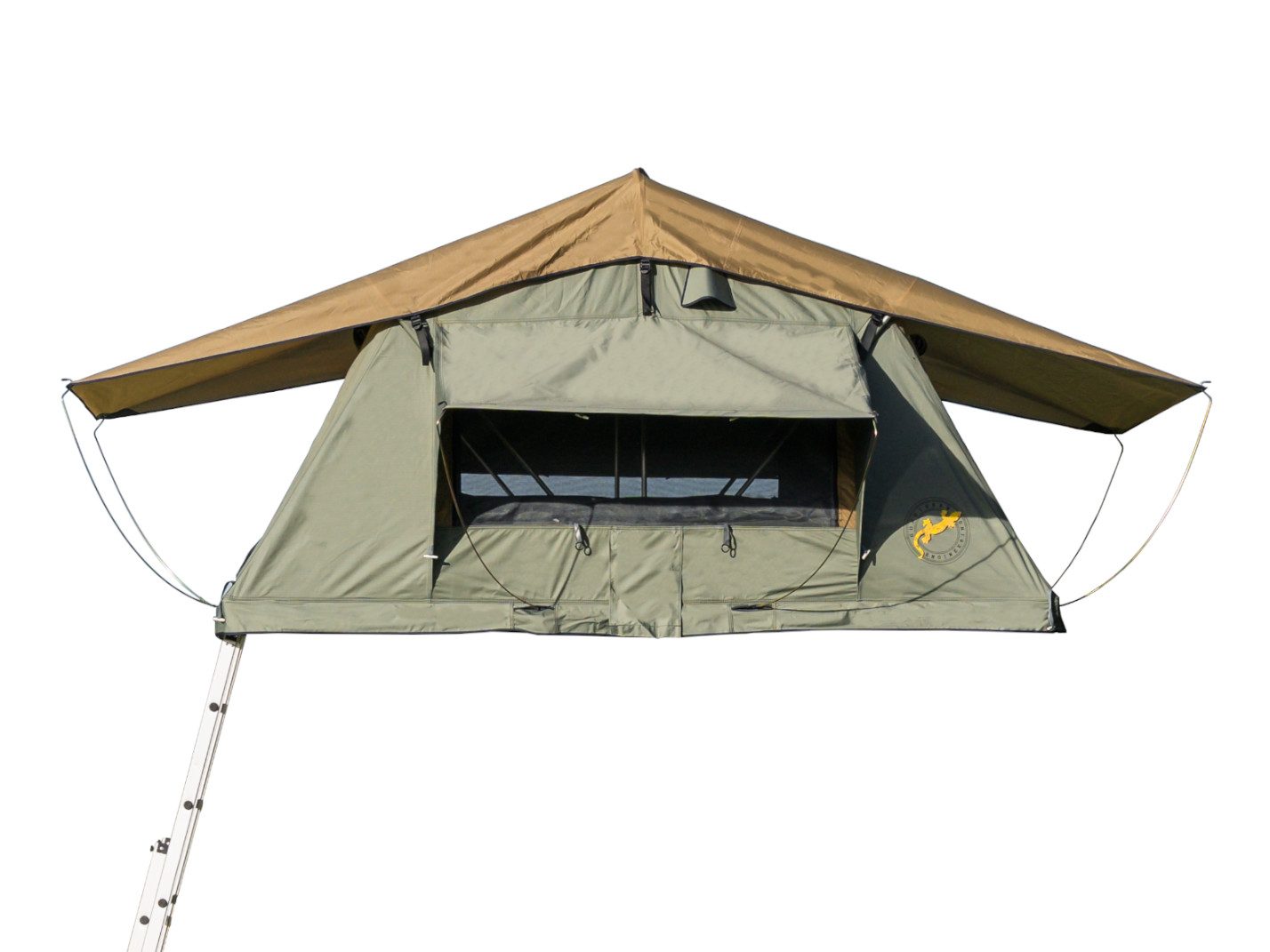
The Tanami Light 140 is a 2-person fold-out softshell that sits between the Ultra Light and Plus models in Gordigear's Tanami folding range. It uses an 80 mm compressed-foam mattress, a 265 gr/m2 ripstop polyester-cotton canopy and a 1000D PVC travel cover. Gordigear states it has no LED lighting and no roof window.
- Thicker 80 mm mattress than the Ultra Light's 60 mm
- Awning/annex compatible with a heavy 1000D PVC travel cover
- Four interior storage compartments and an aluminium telescopic ladder included
- No LED lighting or roof window (manufacturer-stated)
RoofBunk
Explorer
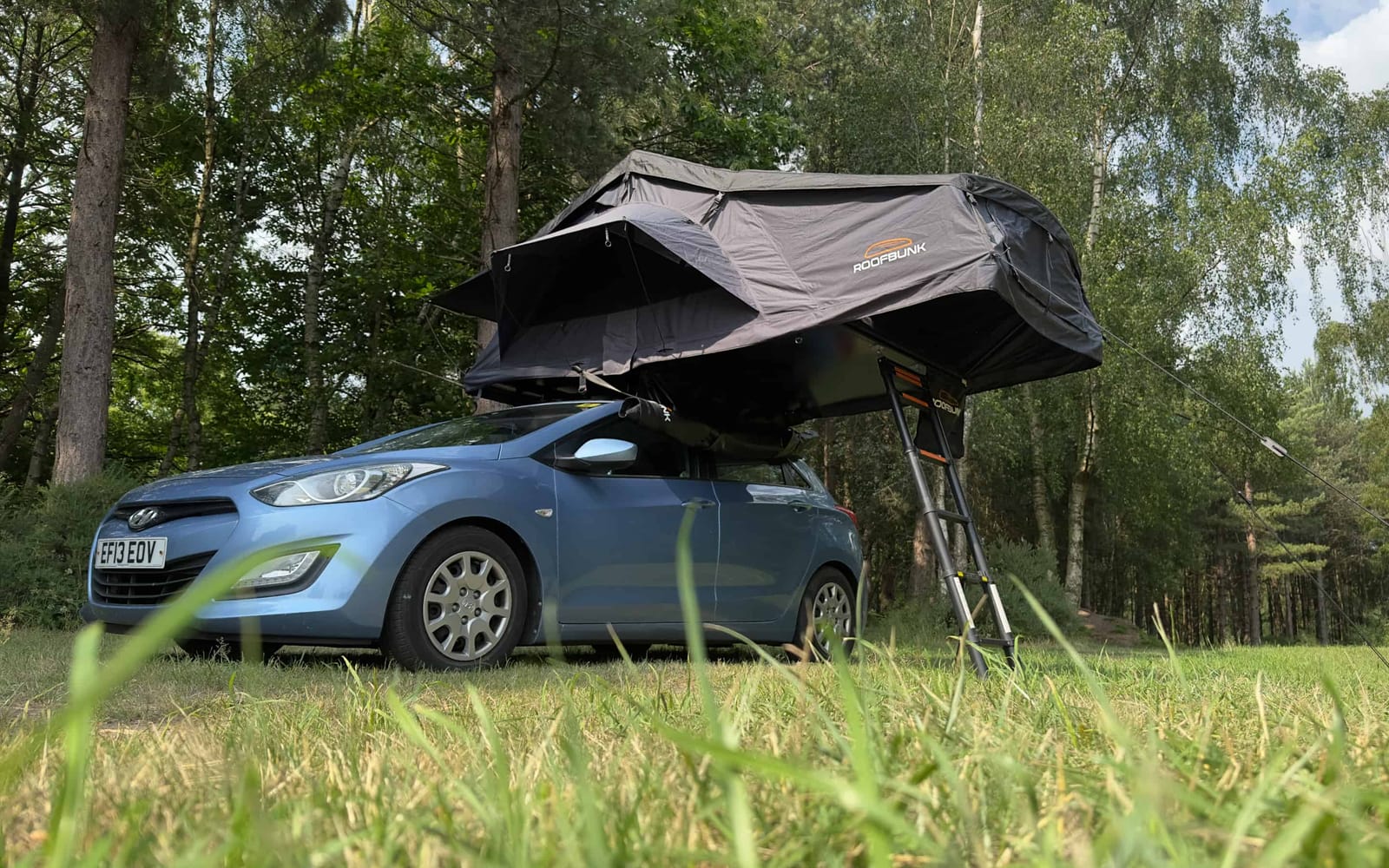
The Explorer is the entry model in RoofBunk's three-tent soft-shell Explorer range, a fold-out tent the maker rates for 2-3 occupants. RoofBunk lists open dimensions of 310 x 140cm - a figure that includes a 70 x 140cm entrance canopy over the ladder - a packed size of 140 x 120 x 30cm and a 6cm memory-foam mattress. It uses a 320gsm poly-cotton ripstop canvas body (3000mm HH) with a 600D Oxford polyester rainfly (5000mm HH) and is marketed as 4-season.
- 4-season rating with a 3000mm-HH canvas body and 5000mm-HH rainfly
- Supplied with a 6cm memory-foam mattress, USB strip light and two skylights
- 2-year warranty, extendable to 7 years per RoofBunk
- Manufacturer does not state what the 50kg weight includes
Which one to pick
Take the Tanami Light 140 if you move camp most days. Take the Explorer if you need the sleeping room more than you need the lighter tent. Beyond that the feature rows below — heater port, skylight, annex, cargo rails — are where the remaining difference lies.
Every specification, side by side
| Specification | ||
|---|---|---|
| Overview | ||
| Type | Softshell | Softshell |
| Opening style | Fold-out | Fold-out |
| Sleeps | 2— worst of the tents compared | 3— best of the tents compared |
| Season rating | — | 4-season |
| List price | $1,610— worst of the tents compared | $1,480— best of the tents compared |
| Weight and size | ||
| Weight | 115 lb— worst of the tents compared | 110 lb— best of the tents compared |
| Packed length | 3 ft 11 in— best of the tents compared | 4 ft 7 in— worst of the tents compared |
| Packed width | 4 ft 9 in— worst of the tents compared | 3 ft 11 in— best of the tents compared |
| Packed height | 13.8 in— worst of the tents compared | 11.8 in— best of the tents compared |
| Living space | ||
| Sleeping length | 7 ft 10 in— worst of the tents compared | 10 ft 2 in— best of the tents compared |
| Sleeping width | 4 ft 9 in— best of the tents compared | 4 ft 7 in— worst of the tents compared |
| Floor area | 37.2 sq ft— worst of the tents compared | 46.7 sq ft— best of the tents compared |
| Interior height | 4 ft 3 in | 4 ft 3 in |
| Mattress thickness | 3.1 in— best of the tents compared | 2.4 in— worst of the tents compared |
| Setup and build | ||
| Setup timeManufacturer's claim where published; otherwise estimated from tent type. Expect longer in practice. | 2 min— best of the tents compared | 4 min— worst of the tents compared |
| Shell material | — | — |
| Fabric | 265 gr/m2 ripstop polyester-cotton blend, polyurethane impregnated and UV resistant | 320gsm poly-cotton blend ripstop canvas body; 600D Oxford polyester rainfly |
| Warranty | 2years | 2years |
| Features | ||
| Integrated LED lighting | No | Yes |
| Heater / HVAC port | — | — |
| Roof skylight | No | Yes |
| Annex available | Yes | — |
| Solar ready | — | — |
| Carries cargo on top | — | — |
| Sources | ||
| Last verified | Gordigear product page | RoofBunk product page |
Related comparisons
- Tanami Light 140vsExpedition Foldout
- Tanami Light 140vsWild Cruiser 160
- Tanami Light 140vsScout
- Tanami Light 140vsWalkabout 56 2.0
Or read the full spec sheets for the Gordigear Tanami Light 140 and the RoofBunk Explorer.