Roof Lodge Lightweight (140) vs Vickywood BAOBAB AIR 135
The Roof Lodge Lightweight (140) and the Vickywood BAOBAB AIR 135 are both softshell tents in the same part of the market, which makes them a genuine head-to-head rather than a comparison across categories. Roof Lodge and Vickywood take noticeably different approaches to the same problem.
By the numbers, the Roof Lodge Lightweight (140) brings 46 kg, 3.36 m² of floor, 120 cm of headroom and sleeps 2. The Vickywood BAOBAB AIR 135 counters with 43 kg, 2.86 m² of floor, 123 cm of headroom and sleeps 2.
On weight they are effectively level — 46 kg against 43 kg — so the roof load question resolves the same way for both. Inside, the Lightweight (140) gives 3.36 m² of sleeping floor against 2.86 m², about 17 percent more, though both are rated for 2. Their list prices are within a few percent of each other, so price is unlikely to decide this one.
They open differently: the Lightweight (140) is a fold-out and the BAOBAB AIR 135 an inflatable. That is not cosmetic — it decides whether headroom is even across the tent or tapers towards one end, and how much of the roof the tent occupies when closed. Canvas differs too: 102 g/m2 Oxford ripstop nylon, PU-coated against 280 g/m2, 3,000 mm water column, UV 50+.
Roof Lodge
Lightweight (140)
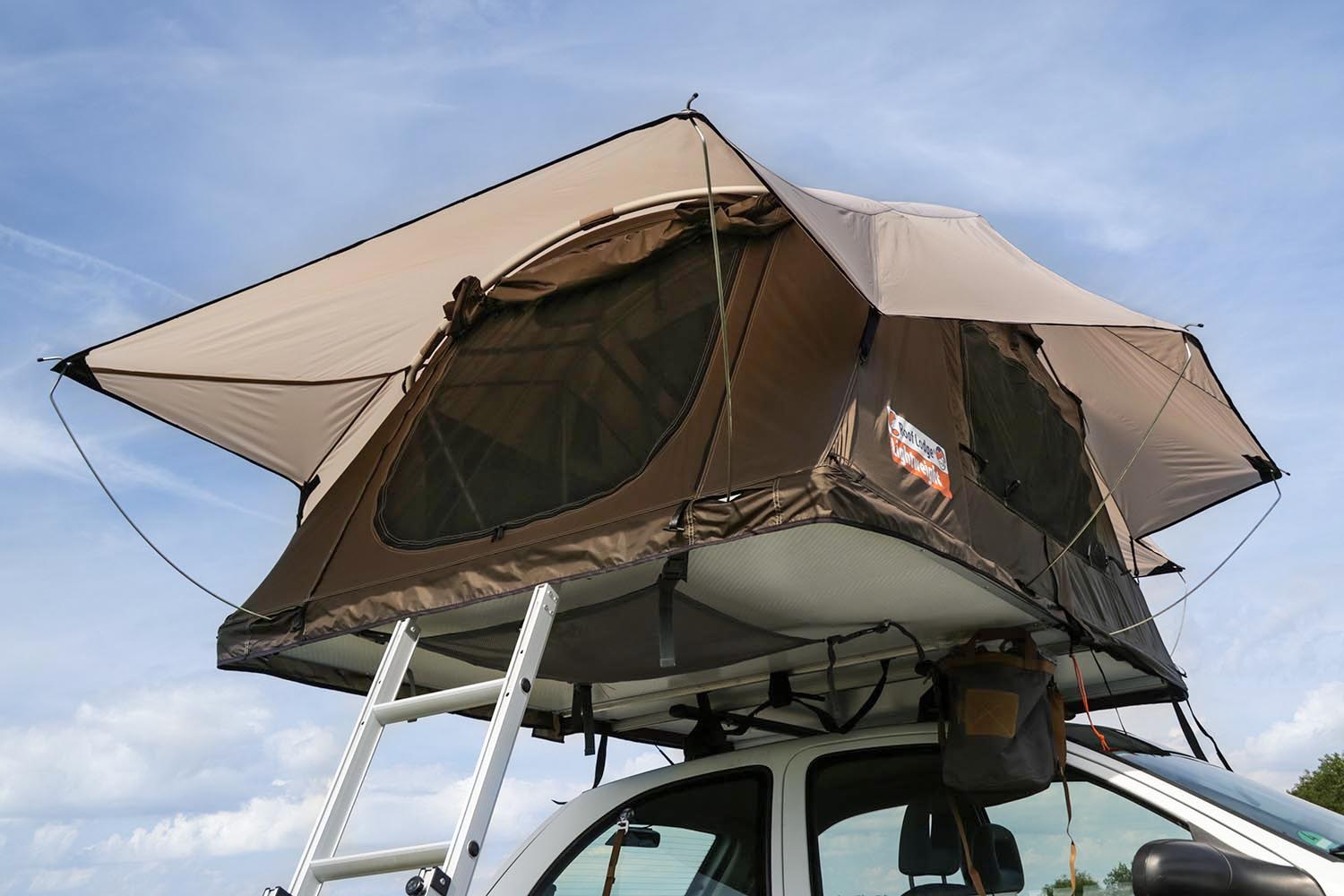
The Roof Lodge Lightweight is a weight-optimised fold-out softshell rooftop tent that replaces the Evolution 2's heavy polycotton with a 102 g/m2 Oxford ripstop nylon canopy over the same thermoplastic honeycomb floor. Nakatanenga quotes an approximate total weight of about 46 kg, lighter than its polycotton Evolution 2, and targets it at vehicles with limited roof-load capacity. It is offered in a single 140 cm width with a 60 mm foam mattress (or an optional 10 cm self-inflating mattress). It shares the Evolution 2 140's fold-out platform, giving an open sleeping area of about 240 x 140 cm (~3.36 m2) at roughly 120 cm interior height; Nakatanenga does not separately publish these figures for the Lightweight.
- Lighter than Roof Lodge's polycotton Evolution 2 thanks to a 102 g/m2 ripstop nylon canopy
- German-made thermoplastic honeycomb floor
- Includes LED lighting, aluminium sliding ladder and two lockable roof windows with mosquito protection
- OEKO-TEX 100 certified mattress (two firmness options) plus long-term spare parts and repairs from Roof Lodge's own German workshop
- Optional thermal inner tent available for cold-weather use, extending it toward year-round camping
- Offered only in a single 140 cm width
Vickywood
BAOBAB AIR 135
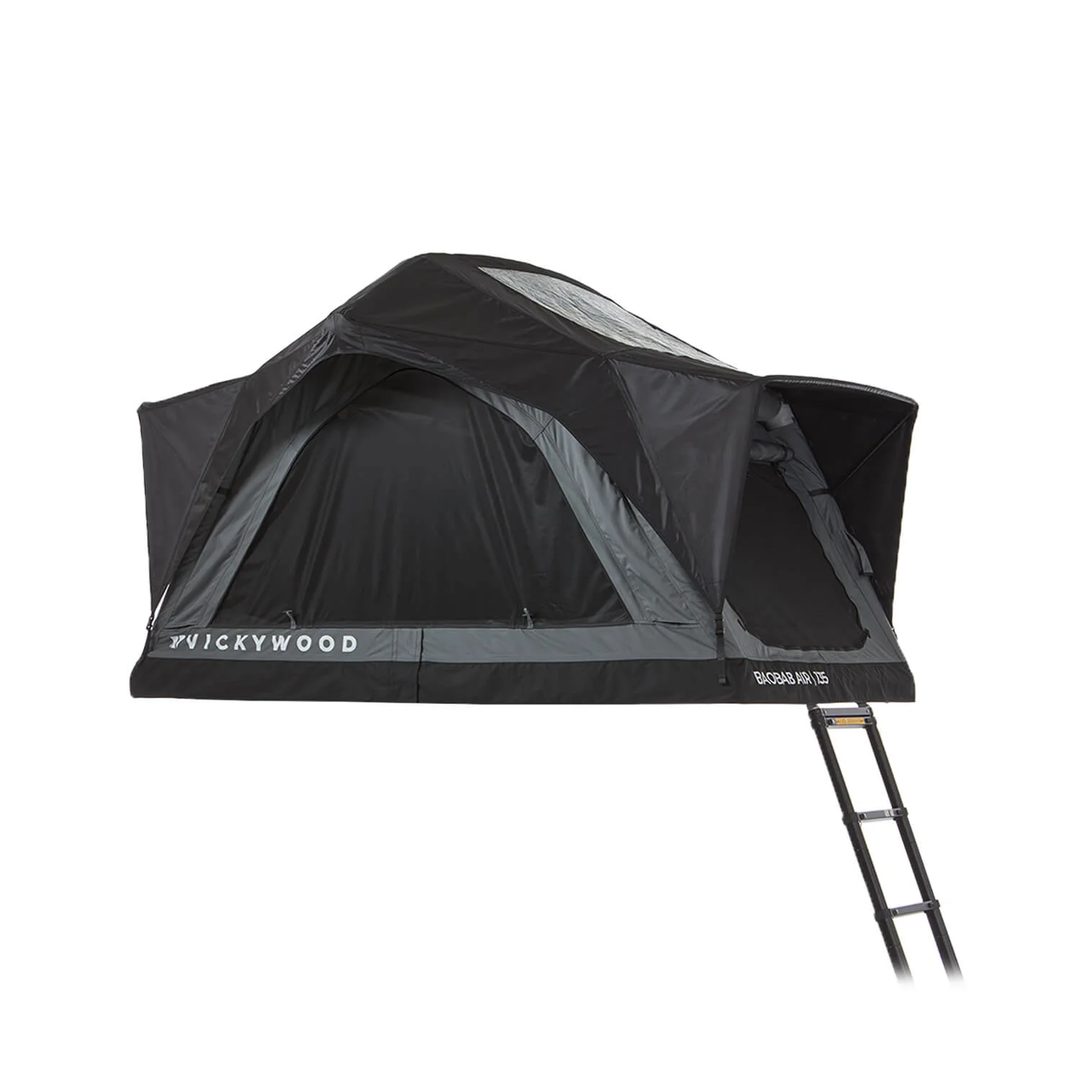
The BAOBAB AIR 135 is Vickywood's inflatable folding tent, using a single-chamber air frame that unfolds as it inflates rather than poles. It sleeps 2 on a 220 x 130 cm area, has two roof windows and dimmable USB-C LED lighting, and the maker states inflation takes over a minute. It is the lightest-weight option among Vickywood's folding models by published figures.
- Pole-free single-chamber inflatable frame
- Low packed height (27 cm) and modest weight
- Two roof windows and dimmable USB-C LEDs
- Mattress thickness not published
Which one to pick
Take the Lightweight (140) if you need the sleeping room more than you need the lighter tent. Beyond that the feature rows below — heater port, skylight, annex, cargo rails — are where the remaining difference lies.
Every specification, side by side
| Specification | ||
|---|---|---|
| Overview | ||
| Type | Softshell | Softshell |
| Opening style | Fold-out | Inflatable |
| Sleeps | 2 | 2 |
| Season rating | 3-season | — |
| List price | $2,210— worst of the tents compared | $2,040— best of the tents compared |
| Weight and size | ||
| Weight | 101 lb— worst of the tents compared | 95 lb— best of the tents compared |
| Packed length | — | 4 ft 7 in |
| Packed width | — | 3 ft 11 in |
| Packed height | — | 10.6 in |
| Living space | ||
| Sleeping length | 7 ft 10 in— best of the tents compared | 7 ft 3 in— worst of the tents compared |
| Sleeping width | 4 ft 7 in— best of the tents compared | 4 ft 3 in— worst of the tents compared |
| Floor area | 36.2 sq ft— best of the tents compared | 30.8 sq ft— worst of the tents compared |
| Interior height | 3 ft 11 in— worst of the tents compared | 4 ft— best of the tents compared |
| Mattress thickness | 2.4 in | — |
| Setup and build | ||
| Setup timeManufacturer's claim where published; otherwise estimated from tent type. Expect longer in practice. | 5 min | ~5 minest. |
| Shell material | — | Aluminum honeycomb base |
| Fabric | 102 g/m2 Oxford ripstop nylon, PU-coated | 280 g/m2, 3,000 mm water column, UV 50+ |
| Warranty | — | — |
| Features | ||
| Integrated LED lighting | Yes | Yes |
| Heater / HVAC port | Yes | — |
| Roof skylight | Yes | Yes |
| Annex available | — | Yes |
| Solar ready | — | — |
| Carries cargo on top | — | — |
| Sources | ||
| Last verified | Roof Lodge product page | Vickywood product page |
Related comparisons
- Lightweight (140)vsFun
- Lightweight (140)vsEvolution 2 (140)
- Lightweight (140)vsMeadowlark 2 XL
- Lightweight (140)vsLite
Or read the full spec sheets for the Roof Lodge Lightweight (140) and the Vickywood BAOBAB AIR 135.